
The Tree That Waited
Some family heirlooms fit inside a box.
Ours had been quietly growing in a Devon woodland for nearly seventy years.
Grandad knew Killerton long before I did. He had grown up playing in its woods as a boy and later spent countless hours wandering the estate with friends as a teenager, some of whom would eventually work there. To him it wasn't a National Trust property or a historic estate. It was simply somewhere to explore, somewhere to get into mischief, and somewhere that felt like home away from the difficulties of home life.
One afternoon in 1957, Grandad and one of his friends carved their names into the bark of a young tree. It was just something two teenagers did without giving it much thought. Not long afterwards he met my Nan and returned to the same tree and carefully carved her name beside his own.
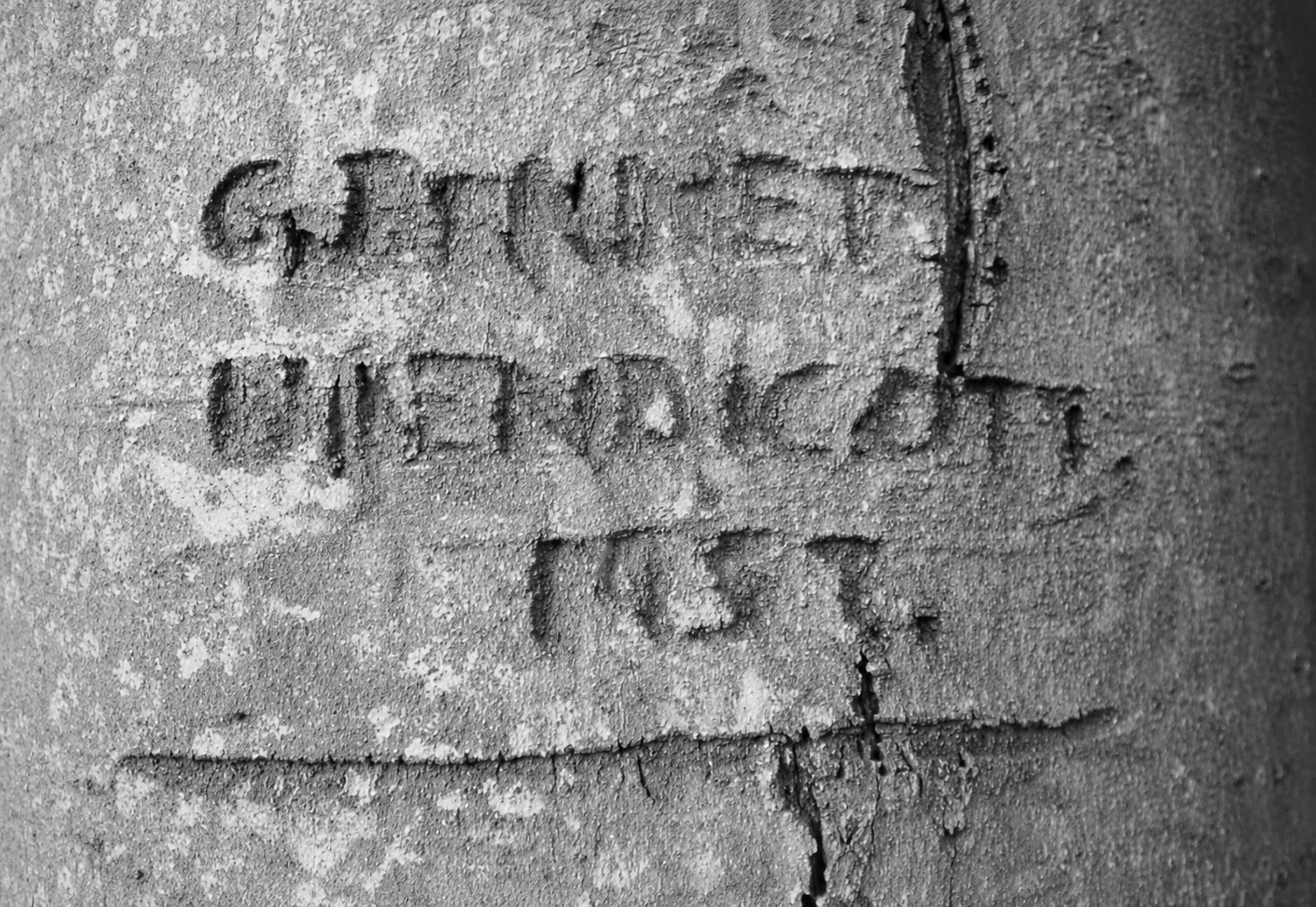
Reads: G BENNET[T] N ENDICOTT 1957
I often wonder whether he ever imagined those few letters would still be there nearly seventy years later.
By the time I came along, the tree had already become part of our family's story. Every visit to Killerton seemed to end there. Grandad would lead me and my little sister Lucy through the woodland before proudly pointing to the carving. As children we never really appreciated quite how remarkable it was. We simply accepted that our Grandad had a special tree hidden in the woods. Looking back now, I realise it was the first time I understood that history wasn't something distant. It belonged to ordinary people. It belonged to our family.
Over the years we visited it dozens of times. The carving became less about the initials themselves and more about the stories that surrounded them. Every visit brought another tale from Grandad's childhood, another memory of growing up in Devon, another reminder that the same woods had shaped his childhood long before they shaped ours.
Then, as the years passed, things slowly began to change.
Grandad's mobility declined and walking became increasingly difficult. Eventually our visits to Killerton with him became much shorter, and before long they stopped altogether. The final restriction came when a bd fall getting into his car resulted in an above knee amputation. In that moment his world reduced in size dramatically and continued to reduce. At home he was restricted to living his life in what was once their living room. When we did return to Killerton without him, something strange happened. We couldn't find the tree.
We searched for hours.
The paths were familiar. The woodland hadn't changed all that much. Yet somehow the exact place Grandad had always guided us to had disappeared. It was as though the tree had simply slipped back into the woodland and hidden itself in a similar way to how he had retreated and become confined to the safety and familiarity of his home.
The day after Grandad died, I was desperate to look through old photos. It had always been one of my favourite past times, to sit on his armchair with huge albums of moments frozen in time. I knew I wanted to get stuck into making something celebratory for his funeral so the photos gave me comfort in those initial shock moments. Like many families do, we sat surrounded by decades of memories spread across the dining table. I picked up one photograph of Grandad sitting on a wooden bench at Killerton. It made me smile remembering the walks, so I placed it in the small pile of photographs we might use.
A little later I found a close-up photograph of the carving itself and was thrilled to at least have a blurred memory to keep as a reminder.
As I laid the two photographs together, something suddenly caught my eye.
Behind Grandad as he sat on the bench, almost hidden in the distance, stood a tree with distinctive hints of markings on its trunk.
I stared at it for a moment before looking back at the close-up photograph.
It was the same tree.
Without ever intending to, Grandad had left us a map. Just like he always had when we were growing up. A treasure hunt. An adventure. I felt 10 years old again and needed to follow the breadcrumbs he left behind.
A few days later we returned to Killerton carrying far heavier hearts than on any of our childhood adventures. This time we weren't wandering without a care in the world. I first walked to the chapel that provided a place of respect, peace and at times sanctuary from the hot summer sun. Grandad was never particularly religious and certainly wasn’t with us as children but in all his mischief and mayhem, this chapel offered him a quite calm. We would sit for hours just looking over the land. Connecting with the ground. Feeling like equals in this grand estate. We stood in the presence of the chapel and I took time to just stop like we always used to, but the normal sound of summer birds that used to sing to us had been replace by grey skies and a growing blanket of mist where the haunting cacophany of crows cawing and circling overhead sounded like a cry of mourning. I’d never seen so many there.
As I watched them circle and sing it felt like there had been a shift in time. The happiness and joy of this sacred place in my life had not gone. It had paused as if bowing its head to acknowledge my loss and give me space to breathe. Crows can often be seen as a bad omen to many but in British folklore they can hold a much deeper meaning. They are loyal and fierce protectors of their family, intelligent, misunderstood and resilient. They are watchers between worlds. Everything Grandad felt like in life. I didn’t realise when I arrived that day, but I needed that moment to acknowledge the passing of time and remind me why I love the magic and mystery of history. I wasn’t the first to stand at that chapel and grieve and I certainly wont be the last.
After taking a moment to pause, we headed along the path trying to map any similarities in the photo. Then we saw something that seemed to fit but there was no bench. On closer inspection there had clearly been a bench there in the past. We looked to the woodland as if standing to retake the photo of him and there it was.
His tree.
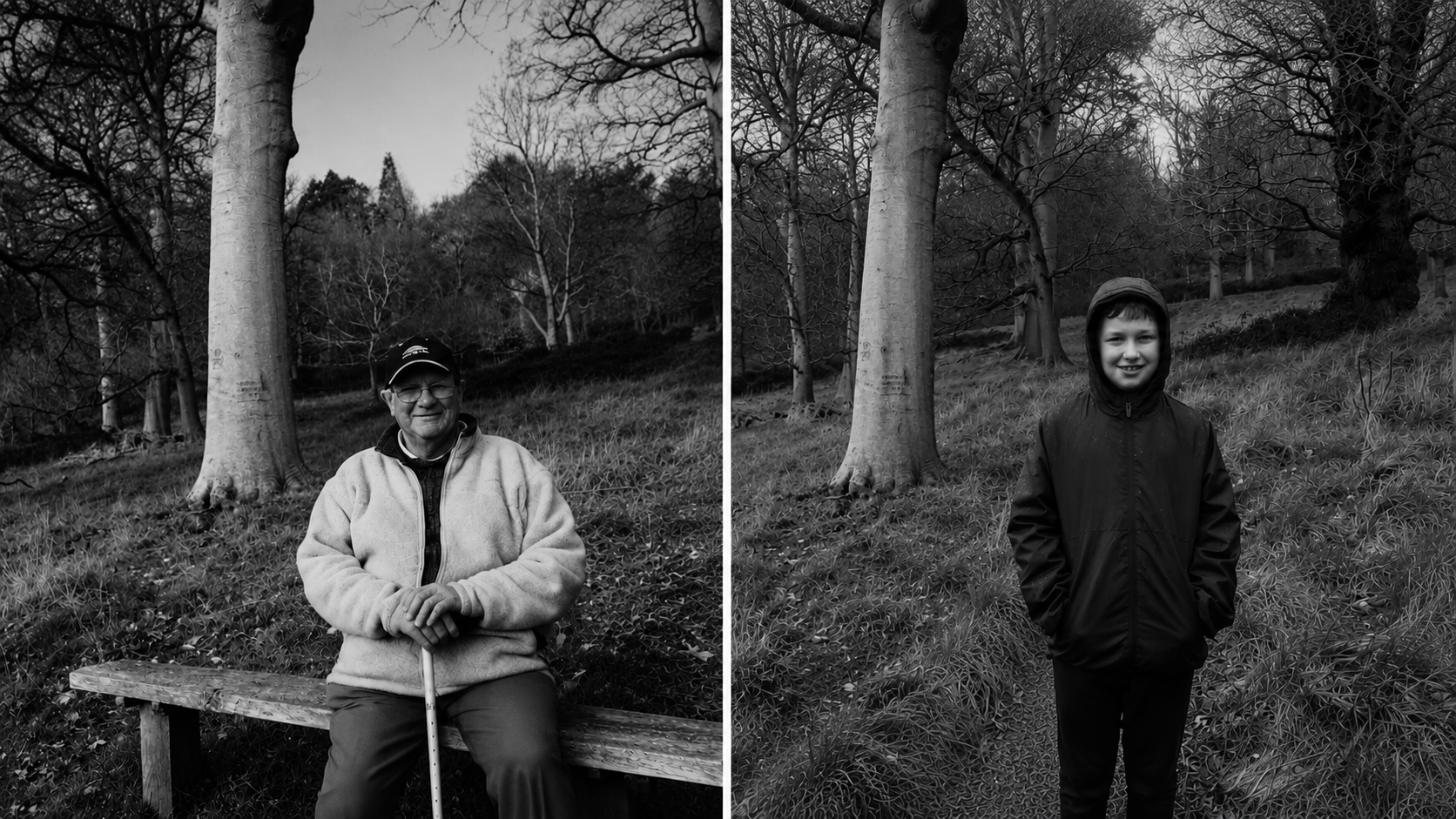
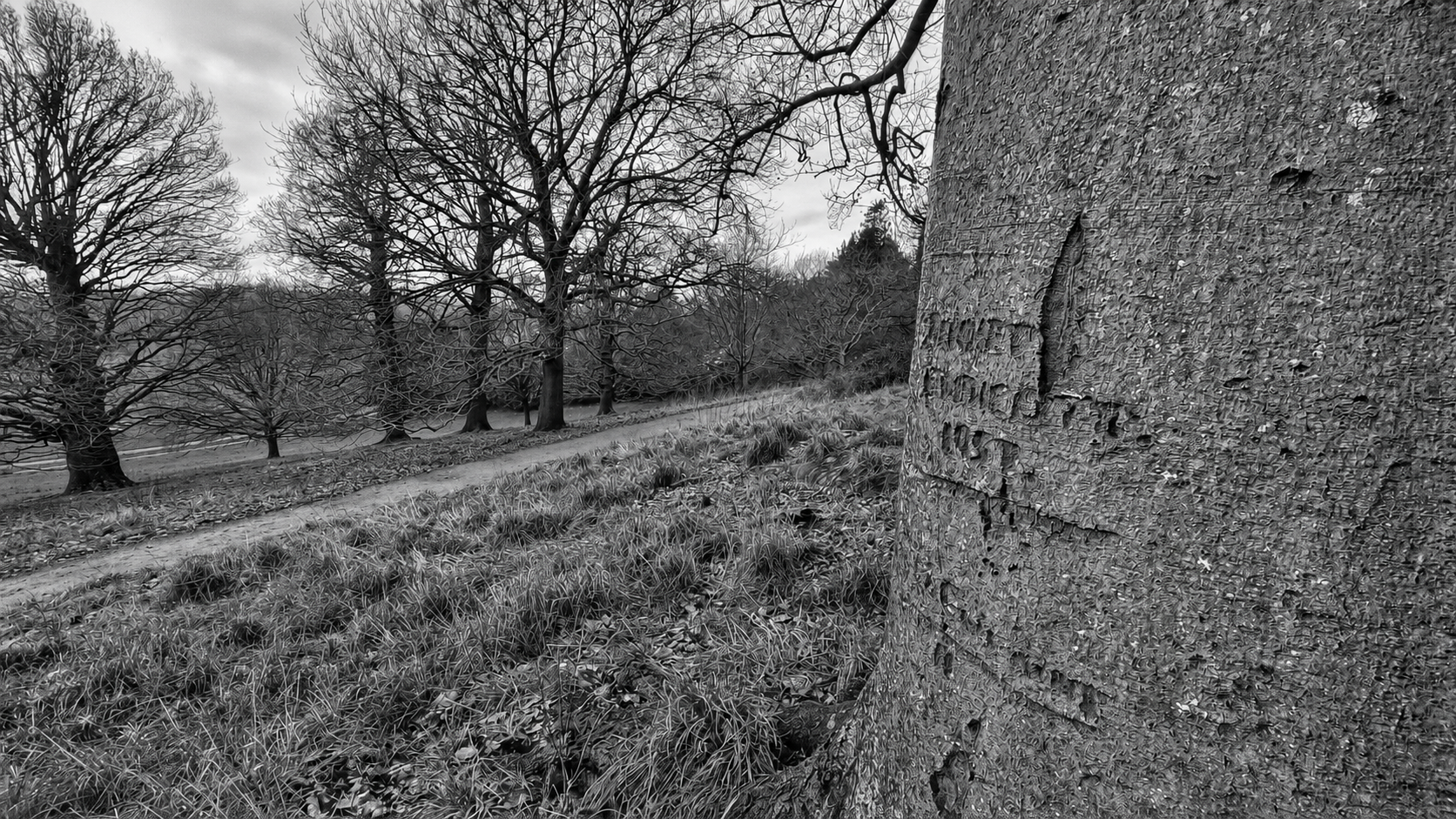
Still standing exactly where it had always been.
The carving was still there too. His name. Nan's name. Seventy years after a young man had stood there with a pocket knife, it remained quietly etched into the bark.
Standing there, I realised something I hadn't understood before. We hadn't simply found a tree.
We had found our way back to Grandad.
The distance between his teenage years and our own grief suddenly felt astonishingly small. We stood exactly where he had stood all those years before, and with my own son too, his beloved great-grandson, and we remembered the countless occasions he had proudly shown us the carving. Somehow, in the middle of losing him, we had been reconnected with him.
That tree means more to me now than it ever did as a child.
People often ask why I care so much about places, why landscapes feature so heavily in my research, or why Devon feels like such an important part of my work. This is why.
History isn't always waiting in an archive or preserved behind museum glass. Sometimes it survives quietly in the places we return to throughout our lives. A tree. A footpath. A gateway. An orchard. They can hold more of life’s grand stories than we give them credit for.
If we know where to look, landscapes become archives too.
