
Beyond the Hardship: Rethinking Victorian Childhood
Victorian childhood is often remembered through images of stern parents, harsh discipline and children sent out to work. But does hardship necessarily mean that childhood, or parental love, was absent?
Mention the words Victorian childhood and a familiar cast of characters quickly appears.
The soot-covered chimney sweep. The hungry workhouse orphan. The factory child standing beside a dangerous machine. The solemn little girl sitting perfectly still for a photograph, watched over by an unsmiling mother and an impossibly severe father.
It is easy to imagine that Victorian children had little childhood at all.
Many undoubtedly experienced lives that would be almost unimaginable to children in England today. They worked long hours, contributed to the family income, cared for younger siblings and lived under forms of discipline that could be physically severe. Illness and bereavement were common, while poverty could turn even a small interruption to a parent’s wages into a family crisis.
Yet this is only part of the story.
The mistake is not in recognising that Victorian childhood could be harsh. It is in assuming that hardship left no room for affection, play, attachment or a meaningful experience of being a child.
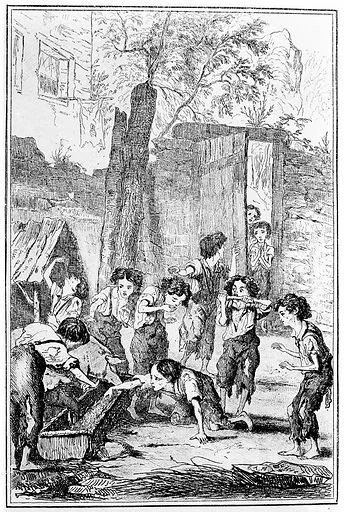
M0013538EB: Illustration of child apprentices outside a textile factory. Source: Wellcome Collection.
There Was No Single Victorian Childhood
A child born into a wealthy household in 1880 inhabited a very different world from one born into an agricultural labourer’s cottage or an overcrowded mining community.
Class mattered, but so did gender, place, health, family size and circumstance. Some children attended school regularly; others fitted lessons around agricultural seasons, domestic duties or paid employment. Some played under the close supervision of parents, nurses and governesses, while others turned streets, fields and waste ground into their own worlds to play in.
Even children living in neighbouring houses might experience family life differently.
One might have been protected from work but closely controlled. Another might have carried substantial responsibilities while enjoying greater freedom to roam. A child might be disciplined harshly and still feel deeply loved. Another might be materially comfortable but emotionally lonely.
There was therefore no single Victorian childhood against which every child’s life can be measured.
Were Victorian Parents Unloving?
One of the most persistent beliefs about earlier family life is that parents were less emotionally attached to their children than parents are today.
The argument can appear convincing. Childhood mortality was high, families were often large and children were expected to accept responsibilities at young ages. Physical punishment was widely used and parents did not always express affection in ways that would now seem familiar.
Historian Linda Pollock challenged this interpretation through her study of parent–child relationships between 1500 and 1900. Her work found considerable evidence of parental concern, tenderness and grief across the centuries. Parents worried when children were ill, delighted in their development and mourned them deeply when they died.
Pollock argued that harsh discipline, should not automatically be treated as evidence that parents lacked affection.
This distinction matters. A parent might have accepted physical punishment as a normal and necessary part of upbringing while also loving the child who was being punished. That does not make the punishment harmless, nor does it mean that children did not fear or resent it. It simply reminds us that historical relationships rarely fit comfortably into modern categories.
People in the past could hold beliefs that now appear contradictory. Affection and authority could exist within the same relationship. So could tenderness and severity.
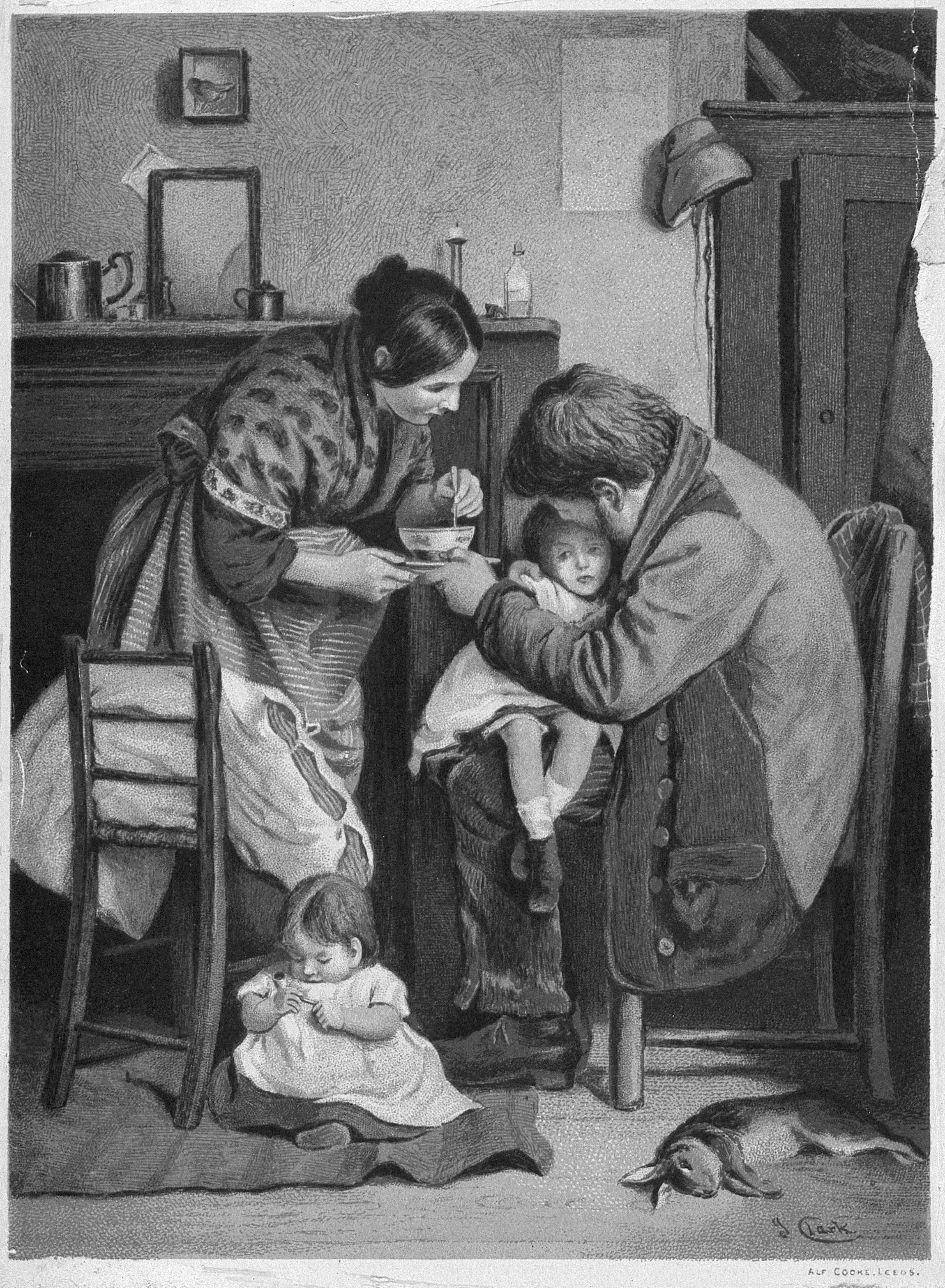
Credit: Sick child illustration. Wellcome Collection. Source: Wellcome Collection.
Why Was Discipline So Important?
Victorian families lived in a society that placed enormous importance on obedience and respectability.
Children were expected to learn how to behave within a clearly ordered household. Parents were not simply raising sons and daughters; they were believed to be shaping future workers, wives, husbands, parents and citizens.
Harry Hendrick has argued that children became increasingly important as future citizens during the nineteenth century. The family, alongside the school, was expected to instil discipline, morality and socially acceptable behaviour.
How that authority was exercised varied considerably.
Hendrick suggests that middle-class parents were more likely to control children through rules, restriction and supervision, while working-class families relied more heavily upon physical punishment. For adults whose working lives offered them little authority, the home could be one of the few places in which their position was recognised.
Joanne Bailey’s research also encourages us to see parents as moral guides operating within the expectations of their own time. What one generation regarded as ordinary discipline might later be judged excessive or even abusive.
This does not mean that every act of violence should be explained away as historically normal. It means that we must distinguish between what happened, how the child may have experienced it, its later implications and how the wider society understood it.
Childhood Within the Family Economy
For poorer families, children’s responsibilities were frequently shaped by necessity rather than by a belief that children did not deserve a childhood.
A father’s wages could be low, irregular or vulnerable to illness, seasonal unemployment and changes in demand. A mother might take in laundry, sell goods, work in agriculture or find other forms of employment. Children’s earnings and domestic labour could make the difference between the family managing and going hungry.
Historian Jane Humphries has reconstructed the experiences of working children through autobiographical evidence. One of the children in her research was William Arnold, born in 1860, who was sent to work in the fields when he was six years old. He remembered the long, hungry days, the loneliness and the distress of calling for his mother when she was working two miles away.
His account is painful because it allows us to glimpse both the working child and the small child beneath the work.
William earned eighteen pence a week and received a meal on Sundays. To the family, his labour had economic value. To William, it meant responsibility and separation from his mother at an age when he still needed her comfort.
Sending a child to work was not necessarily evidence that a parent felt no love. It could reflect the frightening limits of the choices available to the family. Love did not pay the rent or put food on the table. Sometimes affection existed within decisions made under conditions of extreme necessity. Sending a child to work, although potentially painful for both the parent and child, could be the difference between the family holding together and losing the children to the workhouse. Often difficult decisions were simply the lesser of two evils.
That does not lessen the child’s suffering but it helps us understand why it happened.
Responsibilities That Records Do Not Call Work
Not all children’s labour produced a wage.
Older children, especially girls, were frequently responsible for younger brothers and sisters. Anna Davin describes the “little mothers” who could be seen carrying babies, watching toddlers and organising the play of younger children in working-class neighbourhoods.
Their help enabled mothers to complete domestic work or earn money outside the home. It was an important contribution to the family economy, even though it might leave no trace in an occupation column.
Girls could therefore experience childhood as both children and substitute carers. They played with younger siblings while remaining responsible for their safety. Domestic work, education and play overlapped rather than existing as clearly separated parts of the day.
These experiences complicate any simple division between loving and unloving families. Entrusting an older daughter with a baby could represent an enormous burden, but it also emerged from a household in which survival depended upon cooperation.
Victorian children were not always excluded from family life. Sometimes they were deeply embedded within its work and shared responsibilities.
And Children Still Played
Work and responsibility did not erase children's desire to play. Davin's study of working-class childhood in London reveals an inventive world built from whatever children could find. Old soap boxes and pram wheels became carts, discarded tea trays became toboggans, while newspaper, string, rags and even stones were transformed into kites and balls.
These were not necessarily childhoods filled with toys bought especially for children, but neither were they childhoods without imagination or fun. Play fitted itself around work, errands, sibling care and school. Streets and waste ground became playgrounds and everyday objects became toys.
This is perhaps another reason why judging Victorian childhood entirely through adult ideas of hardship can be misleading. Children did not simply experience the circumstances adults created for them; they also made something of those circumstances themselves.
Did School Create the Modern Childhood?
The expansion of compulsory education helped transform the place of children within the family.
The 1870 Education Act established the framework for education in England and Wales, while legislation passed in 1880 made attendance compulsory for children between five and ten. The school-leaving age was gradually raised over the following decades.
Hugh Cunningham suggests that if school age helped define who was considered a child, these changes effectively extended childhood. Time that had once been available for work became increasingly associated with learning, development and preparation for adult life.
But the transformation was not immediate.
Poor families still depended upon children’s labour. Rural children missed school during harvests, while others worked before or after lessons. Girls might be kept at home to care for siblings. Parents were sometimes prosecuted for non-attendance even when they believed that the family could not manage without the child’s help.
Schooling offered children new opportunities, but it also brought the state into family life. Government, teachers and attendance officers increasingly claimed the authority to decide where a child should be and how childhood time should be used.
Children were becoming more protected, but also more closely regulated.
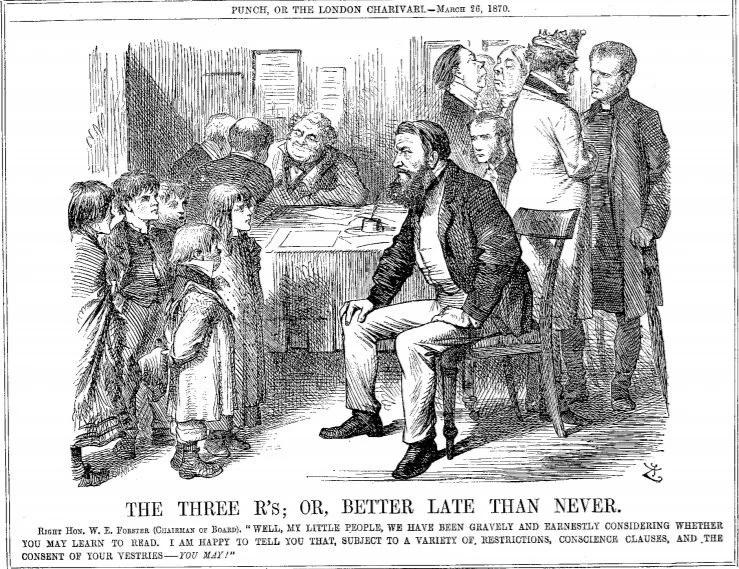
John Tenniel, Public domain, via Wikimedia Commons
Looking Beyond the Unsmiling Photograph
Our impressions of Victorian families are partly shaped by the records that survive.
A formal photograph captures a moment of stillness, not the laughter that might have occurred before or afterwards. A census records relationships and occupations, but not bedtime stories, favourite games or the person a frightened child sought for comfort.
Even affectionate relationships can be difficult to see.
Love might be expressed through food saved for a child, clothes repeatedly mended, medicine obtained at considerable expense or a grandparent taking in a grandchild during a family crisis. None of these acts necessarily produced a record describing the emotion behind them.
This is where genealogy can add so much to the history of childhood.
A child found living with grandparents may initially look like someone separated from their parents. Further reconstruction might reveal that the grandparents lived next door, that the mother visited regularly or that the arrangement allowed a widowed parent to continue working. Alternatively, it might uncover bereavement, abandonment, poverty or a permanent transfer of care.
The census gives us the structure of the household. It rarely tells us what that household felt like.
Childhood Could Be Hard and Still Be Childhood
Victorian children created their own childhoods in the best way they knew how.
They played, formed friendships, sought affection, tested boundaries and created meaning from the worlds around them. But they did so within circumstances that could demand labour, obedience and responsibility at much younger ages than we would now consider acceptable.
Recognising this does not require us to romanticise hardship. Nor should evidence of parental affection be used to minimise exploitation, violence or neglect.
Instead, it allows us to see Victorian families in greater depth.
A demanding childhood was not necessarily an empty one. A strict parent was not necessarily an unloving one. A working child did not cease to experience the world as a child simply because adults depended upon their labour. Their version of childhood may have differed from what others experienced but they were creating childhood in their own way.
The more interesting history lies between the extremes.
Victorian childhood was not simply a tale of misery from which modern childhood eventually rescued children. It was a collection of unequal, complicated and deeply human experiences in which love and hardship, freedom and responsibility, protection and control continually existed beside one another.
Every Victorian child had a childhood.
The real question is what kind of childhood they were able to have.
Further Reading
Joanne Bailey, ‘The History of Mum and Dad: Recent Historical Research on Parenting in England from the 16th to 20th Centuries’, History Compass, 12.6 (2014), pp. 489–507.
Hugh Cunningham, Children and Childhood in Western Society since 1500 (Longman, 1995).
Anna Davin, Growing Up Poor: Home, School and Street in London, 1870–1914 (Rivers Oram Press, 1996).
Harry Hendrick, Children, Childhood and English Society, 1880–1990 (Cambridge University Press, 1997).
Jane Humphries, ‘Childhood and Child Labour in the British Industrial Revolution’, Economic History Review, 66.2 (2013), pp. 395–418.
Linda A. Pollock, Forgotten Children: Parent–Child Relations from 1500 to 1900 (Cambridge University Press, 1983).
