
Every Childhood Leaves a Story
"There are no ordinary childhoods. Every child grows up within a family, a community and a world that quietly shapes who they become."
When we think about history, we often picture kings and queens, great battles or remarkable inventions. Even when we turn to family history, our attention is usually drawn to the adults. We search for occupations, military service, marriages, wills and property, piecing together the lives of those who came before us.
Children, by comparison, can seem almost invisible.
They appear briefly in census returns before disappearing into adulthood. School records survive for some but not others. Their voices are rarely preserved, and the ordinary moments that mattered most to them often went unrecorded.
Yet every adult was once a child.
Every inventor, labourer, farmer, teacher, sailor, servant and parent first experienced the world through childhood. Long before people shaped history, history quietly shaped them through childhood.
That simple idea is what fascinates me.
For many years, childhood was often treated as little more than a stepping stone towards adulthood. Historians now recognise something much richer. Childhood was never simply a waiting room for adult life. It was a unique stage of life with its own friendships, responsibilities, freedoms, fears, games, relationships and memories. There has never been a single story of childhood. Every child experiences the world differently, shaped by family, place, opportunity and circumstance. My research currently explores childhood from 1800 to present, revealing just how varied those experiences could be.
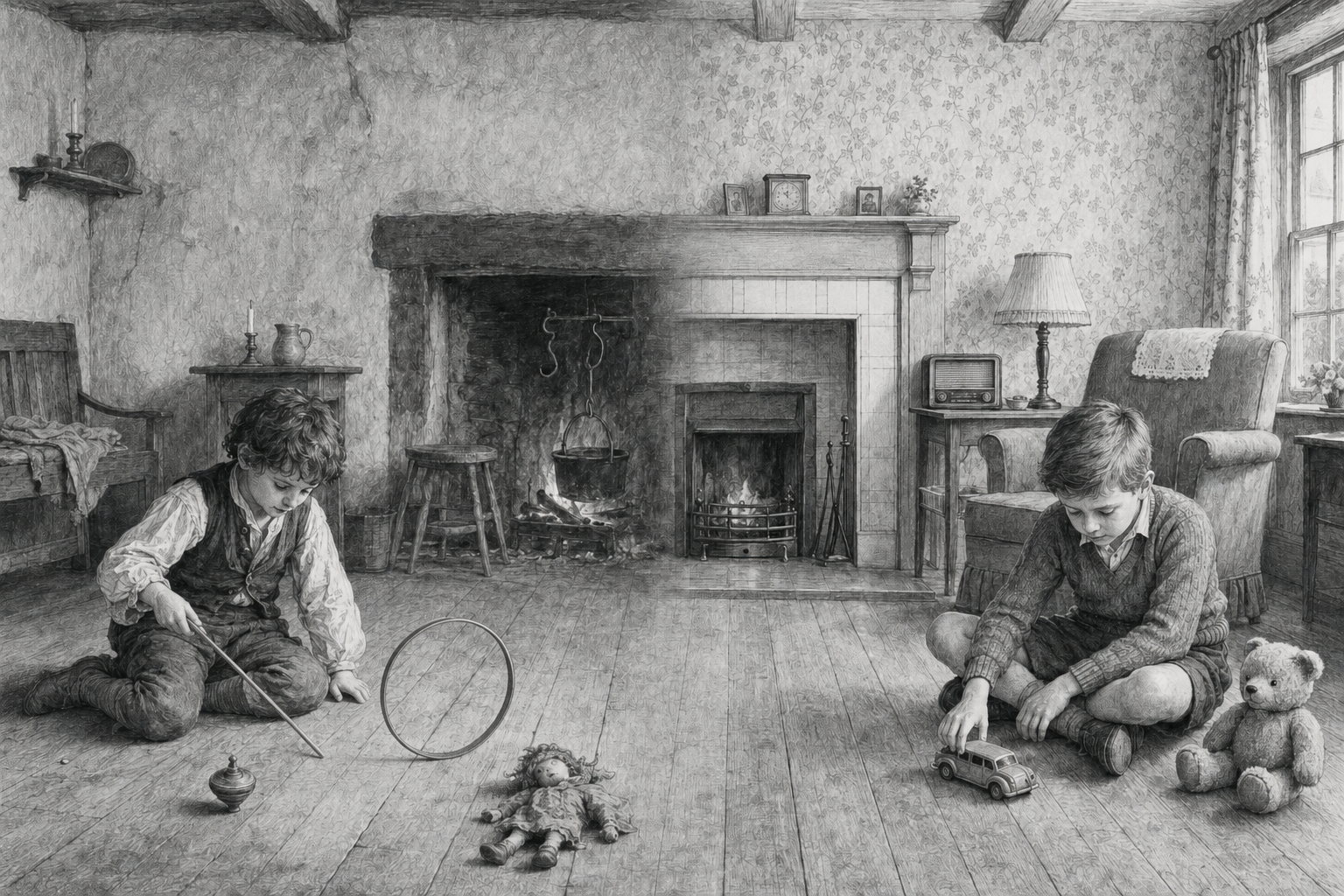
Children at play, generations apart.
Some children spent their days working in fields or factories. Others attended school for the first time as compulsory education expanded. Some grew up surrounded by brothers, sisters and grandparents, while others were raised by neighbours, relatives or complete strangers. Some enjoyed wide open countryside as their playground, while others carved adventures from crowded streets and back alleys. Even something as universal as play looked remarkably different depending on where and when a child lived.
What interests me most is that childhood leaves traces everywhere, even when children themselves seem absent from the historical record.
A worn school logbook.
A census entry describing a "nurse child."
A scratched name inside a favourite book.
An old tree carving remembered by a grandparent eighty years later.
Individually they may seem insignificant. Together they tell us how children experienced the world around them.
As a genealogist, I've often found that understanding childhood transforms the way we understand an entire family. A child recorded with another household isn't simply a genealogical puzzle to solve; it may reveal illness, poverty, bereavement, migration, informal fostering or an extraordinary act of kindness. A grandfather living next door isn't just another relative on the census; he may have been providing childcare, passing on stories or helping the family survive difficult times. Looking at childhood encourages us to ask different questions of familiar records.
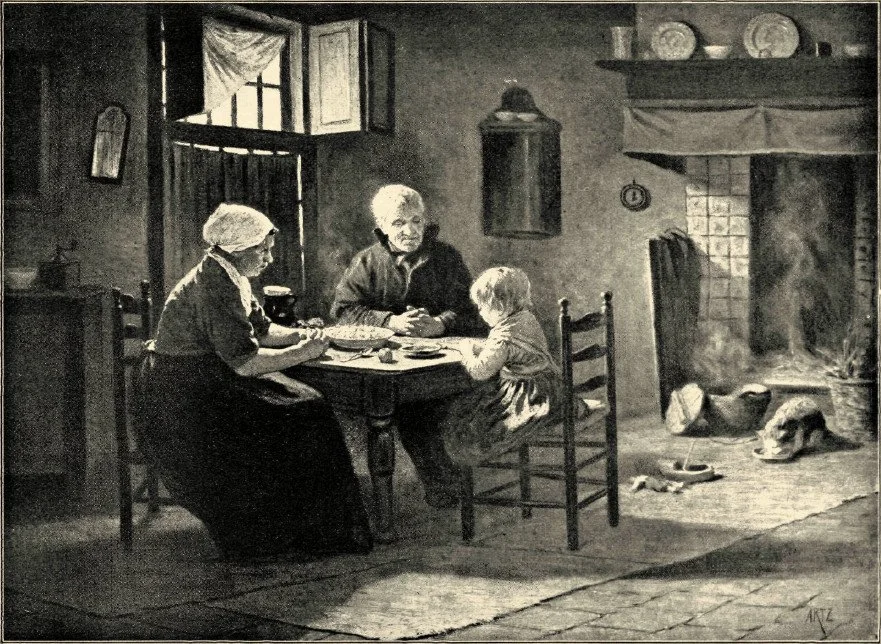
Child with Grandparents
It also reminds us that children weren't simply shaped by history, they helped shape it too.
The games they played reflected changing ideas about domestic expectations, education and leisure. The work they carried out supported family economies. Their schooling reflected new expectations about their role in the community and opportunity. Their relationships with parents, grandparents and wider communities evolved alongside changing ideas about family life. Even the landscapes they explored became part of the adults they would eventually become.
Perhaps that's why childhood history feels so personal.
We all recognise something of ourselves in it.
Whether we grew up climbing trees, helping on a family farm, playing in quiet village lanes or kicking a football around an estate, our own memories become a bridge to understanding those who came before us. The details may differ, but the emotions often feel surprisingly familiar.
This section of my website is dedicated to exploring those childhoods.
Sometimes we'll follow the lives of Victorian children through census returns and school records. Sometimes we'll explore the history of play, family life or rural childhood. Sometimes we'll uncover the forgotten stories of children who have almost disappeared from history altogether.
Every census entry, every faded photograph and every family story has the potential to reveal something much bigger.
Not just who our ancestors were.
But what it was like to grow up in their world.
Because every childhood leaves a story.
